Boiler cleaning systems

Centre of Competence for On-load Boiler Cleaning
Headquartered in the German town of Wesel, Clyde Bergemann GmbH is the competence centre for on- load boiler cleaning within the Clyde Bergemann Power Group. The company’s typical fields of operation include thermal energy conversion processes based on coal, waste and/ or biomass. For over 70 years, we have focused our work on the development and production of efficient solutions for on-load cleaning of heating and reaction surfaces. We offer an extensive range of cleaning devices specifically designed for the different cleaning requirements within a boiler by applying various cleaning methods and nozzles as well as nozzle arrangements.
Technology leader with process expertise
As a pioneer in the industry, we play a vital role in shaping cleaning technology. As such we were the first in the market successfully applying water for furnace cleaning. Likewise, we were quick to spot the advantages of demand-driven boiler cleaning which is performed according to the actual deposit situation and not following a fixed cleaning scheme. A whole new philosophy has evolved out of the advantages of demand-driven boiler cleaning. We call this “SMART CLEAN”.
Complete Solutions & Life-long Support
We construct and deliver complete solutions in which hardware, software, shut off and regulation valves, as well as controllers, are perfectly coordinated. Our diligence, which is applied by our experts in the design of boiler cleaning systems, is also apparent during installation, commissioning and servicing throughout the service life of our technology.
Your Benefits:
- Extended boiler availability
- Increased boiler efficiency
- Controllable deposit build-up regardless of flexible boiler operation and changing fuel mixture or varying fuel quality
- Effective and efficient boiler cleaning
- Professional consultation in all boiler cleaning matters
- Procedural expertise from more than 60 years of experience in power plant boiler cleaning solutions
- Comprehensive service
- Training for your employees by our own experts
 Areas of use
 Our offer for power plants
Careful Engineering – The Key for Effective Boiler Cleaning
Every system, every deposit build-up is distinctive and requires comprehensive design planning. Decades of experience in a wide range of applications showed that only careful design – as sketched as an example in the following – will lead to the best cleaning results.
Choosing the Right Cleaning System
The chemical composition of the fuel influences the formation of slagging and fouling. The more detailed the information available, the better the suitable cleaning device or combination of different devices for a coordinated overall system can be selected. Further selection factors we consider are the boiler design and specific design parameters like flue gas temperatures and steam parameters.
 Factors of Success for Cleaning with Steam or Air
The choice of parameters of the cleaning system
Economic arrangement of the selected sootblowers is also important. The sootblower should provide complete coverage of the contaminated tube surfaces whilst avoiding overlaps to prevent the danger of damage from overcleaning. The sootblower cleaning range must be verified depending on the geometries of the surfaces to be cleaned, the pitch and the superheater package height.
Selection of the right nozzle depends on the degree of the deposit formation. The decision for the nozzle shape, nozzle diameter, application angle and blowing pressure is derived from this. The CFEIII nozzle with a specific nozzle geometry was developed for the extreme cleaning requirements of the black liqour recovery boilers.
We use self-developed and scientifically verified engineering software to ensure design planning quality. This consistent approach makes every design objective and can be replicated.

Fit for Purpose Technology Designed from Experience
Standard-Compliant Desig
Our on-load boiler cleaning systems correspond to national and international safety provisions and our company is DIN ISO 9001 certified. Also important to us is the safety of power plant employees who are responsible for handling sootblowers, therefore we pay close attention to details. For example, we only use bolts made of standard-compliant materials for secure screw connection of the steam-carrying lance tube. Particular safety-requirements can be covered by special designs.
Durable Assembly
As the sootblower travel length increases, the lance or blowing tube‘s weight imposes huge forces. To limit bending tension, these tubes are designed in multiple parts and with different tube wall thicknesses. The first partial tube has the largest wall thickness to ensure structural stability.
Generally, we determine material composition and wall thickness for lance or blowing tubes specifically for each installation to match the application conditions and the operational frequency of each individual sootblower. This attention to detail will provide lifetime and cost benefits for our customers.
Avoiding Condensate Corrosion
Incorrect sizing of the internal steam feed tube can have expensive consequences. If the feed tube outlet is positioned too far from the boiler wall opening, the steam can condense in the feed tube whilst the sootblower is not in operation. Consequence: Condensate continually drips on the inner lance tube wall, eventually leading to corrosion.
Clyde Bergemann feed tubes always terminate within the lance tube after the sootblower front plate, so that the heat emitted by the boiler wall opening is used to prevent condensation.
Safety
Generally, all steam-carrying components are discon- nected from the drive. This ensures the safety of your employees and protects the sootblower from expensive damage.
Protection of Mechanical Components
Drive unit suspension is selected to balance the weight on several suspension points. This prevents overloading of mechanical components, e.g. by a single spindle, from the very first operation.

The Complete Range of Sootblowers for Cleaning with Steam or Air
For Travels up to 20 Meters

SMART RSG – Maximum Flexibility
for On-load Cleaning of the Convection Area
Lower Steam Consumption, Lower Erosion – While still Achieving an Enhanced Cleaning Effect
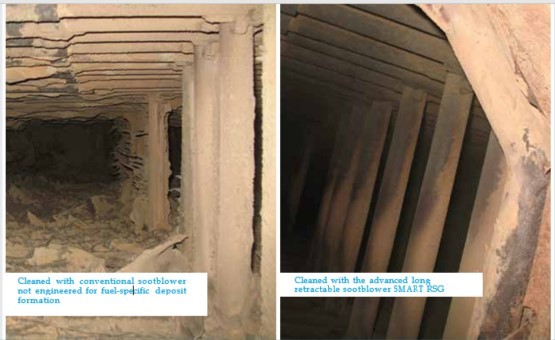
Deposits in the convective heating areas tend to have an uneven distribution.
The use of conventional cleaning technologies can lead to the following issues: Insufficient cleaning of badly affected areas due to cleaning parameters set to less deposited areas; tube wear in zones with less or no deposits due to intensified cleaning of heavily deposited areas.
The non-uniform fouling distribution requires a corresponding flexibility from the on-load boiler cleaning system to achieve the best and most economic cleaning results. Certain fuels have a tendency to build- up strong deposits which push conventional retractable sootblowers to their limit. This situation encouraged us to the further development of the sootblower to a selective and efficient working cleaning device.
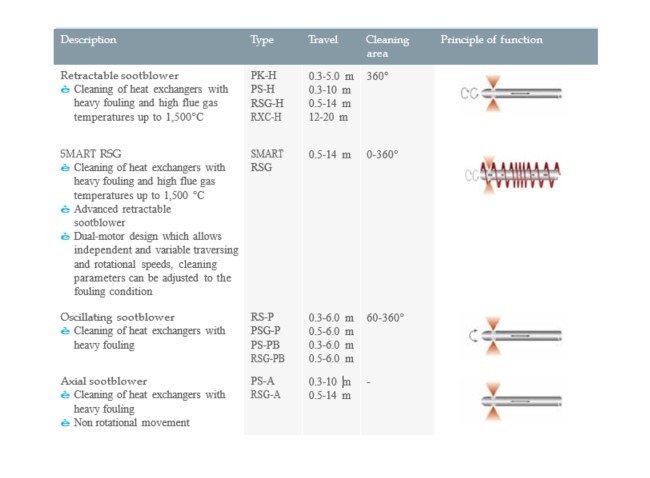
The SMART RSG is a retractable sootblower with a unique dual-motor design which allows independent and variable traversing and rotational speeds. The speeds can be varied at any time. All parameters required for cleaning – traversing speed, rotational speed, blowing pressure, blowing angle – can be set as required with a flexible combination. This leads to different cleaning intensities that best match the fouling condition.
Freely adjustable cleaning parameters of SMART RSG
| traversing speed | freely adjustable |
|---|---|
| rotational speed | freely adjustable |
| blowing pressure | freely adjustable |
| intensive cleaning | freely adjustable |
| repeat cleaning | freely adjustable |
| oscillation yes/no | freely adjustable |
Your Benefits:
- Cleaning parameters can be adjusted to match the
- fouling condition
- SMART RSG minimises erosion
- SMART RSG economically uses steam or air –
- cleaning media savings of up to 60% Extended boiler availability
- Improved heat transfer
- Increased boiler efficiency
- When combined with diagnostics/analysis modules of the SMART CLEAN platform, it is turned into a fully automated on-load cleaning system that can be seamlessly integrated into your control system
Factors of Success for Cleaning With Water
Water Jet Quality is Vital
To achieve the water jet quality required for successful on-load boiler cleaning, several parameters must be perfectly aligned with each other and to slagging and fouling.
Nozzle geometry and nozzle diameter, as well as the blowing pressure, are essential factors that determine the water jet quality. In the cleaning operation, the water impact angle, the water volume and the size of the covered area must match the intensity and characteristics of the deposit. By varying the water jet speed, the impact time is adjusted to the fouling intensity.
Two Cleaning Principles When Using Water
- The wall blower F149 achieves its cleaning effect via the peak impact pressure. The kinetic energy of the blowing jet is converted to pressure energy when escaping the nozzle.
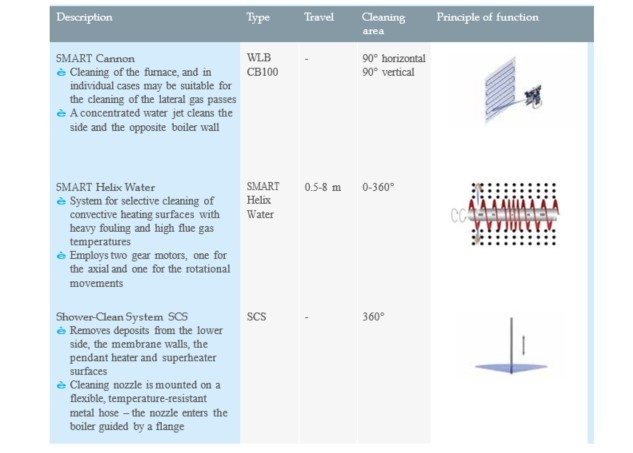
- The SMART Cannon and the Shower-Clean System SCS do not achieve their cleaning effects by peak impact pres- sure. Water penetrates the deposits‘ pores, vaporises due to direct heat transfer, and leads to a sudden increase of volume. The deposits then break off.
The retractable sootblower SMART Helix Water uses a combination of both cleaning principles.

The Complete Range of Water Cleaning Devices
When Using Coal, Waste or Biogenic Fuels

SMART Cannon
The Most Effective Method of Furnace Cleaning
Water: a Proven Alternative
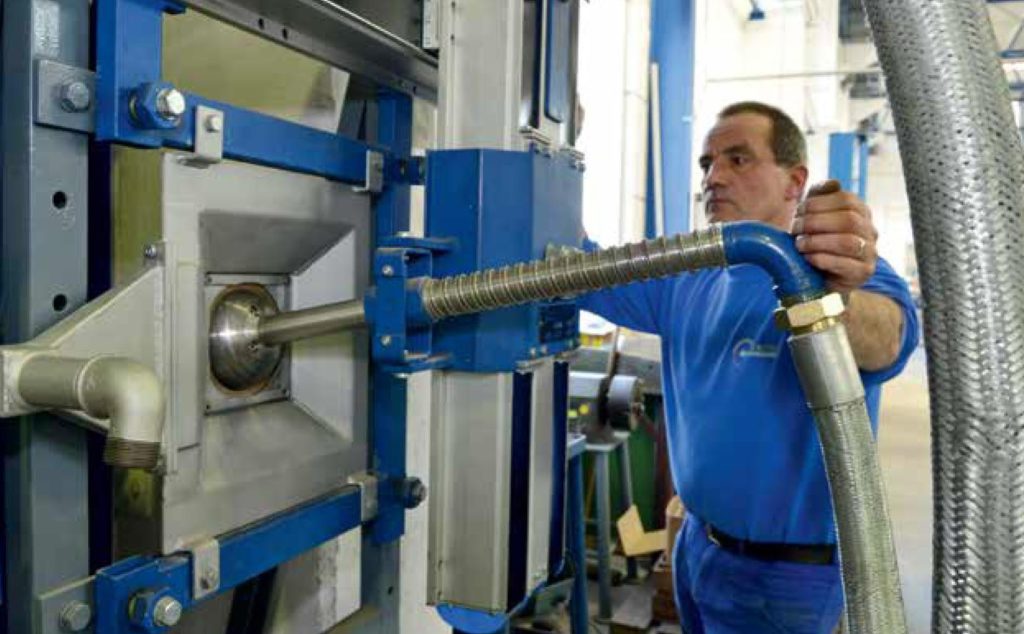
The high temperatures in the furnace may lead to slagging hotspots. As a specialist for on-load boiler cleaning, we have recognised the potential of cleaning with water very soon. The SMART Cannon has proven its efficiency in furnace cleaning around the world. The assembly is based on two linear drives and a ball-shaped suspension for the blowing lance. The light, compact design is made for the challenging conditions in the power plant. Each of the horizontal and vertical linear drives is subjected to quality inspection with a 100 kg weight before delivery. Load resistance of the drives and uninterrupted current intake of the motor are therefore ensured.
Operation Principle
Due to its specially developed control technology, the water jet creates a meander shaped pattern on the side and opposite wall. With its horizontal and vertical blowing arc each of 90°, a single cannon can clean a large area of the furnace. The cleaning configurations can be determined precisely and repeated consistently. The lance movements are directly and continuously monitored. We do not rely on monitoring the drive unit alone, therefore preventing uncontrolled water application into the furnace.
To clean opposite walls at a distance of up to 25 meters, we combine different nozzle sizes and blowing pressures.
Unbeatably Efficient
A single SMART Cannon cleans a much larger area– coloured blue in the above figure – than several conventional wall blowers together – cleaning areas coloured white in the above figure.

High Performance, Compact Design
Your Benefits:
- Heavy-duty cleaning system suited for the high furnace temperatures
- Compact design
- Cleans areas difficult to access, e.g. hopper, centre wall
- Cleaning figures can be individually adjusted to boiler geometry – simple change on demand
- Precise, repeatable water jet positioning
- Open system to connect different control systems

SMART Cannon uses a gear with constant drive force
Technical Highlights
Water-Jet Quality: A specifically developed high-performance nozzle creates a concentrated water jet. A rectifier calms the water jet at the lance entry. A very precisely designed nozzle end prevents the water jet from expanding.
Flexible Blowing Figures:The control programme enables precise adjustment of the blowing configuration to match the geometry of the area to be cleaned. Different monitoring functions ensure blowing figure repeatability.
Protection of Critical Areas:The control system can ensure certain areas are excluded from water jet application.Large Cleaning Area and Reliable Flue Gas Sealing:The blowing lance is mounted in a ball-shaped suspension that gives the SMART Cannon its large cleaning range while also securely sealing it against the flue gas outlet.
High-Performance Motor:Moving parts can be blocked by deposits at any time. The direct current servo drive used also works at a constant drive force at this resistance, ensuring reliable operation of the SMART Cannon.
Low and Easy Maintenance:Robustly designed assembly consisting of a vertical and horizontal linear drive. An individual can perform replacement without using any pulleys.
SMART Shower-Clean System (SCS) Increased Availability for Waste and Biomass Fired Boilers
Suited for Different Deposit Characteristics
The SMART SCS uses water as the cleaning medium. Located on the boiler roof, it removes deposit from the lower side, the membrane walls, the pendant heater and superheater surfaces.
The cleaning nozzle is mounted on a flexible, temperature-resistant metal hose. The nozzle enters the boiler guided by a flange, which is opened and closed through an electropneumatic valve.
The surfaces of deposits are characterised by different properties. Their development depends on the chemical composition of the fly ash in combination with the actual flue gas temperature. The cleaning nozzle forms a water jet with a defined stectrum of water droplets and momentum. To achieve successful cleaning, it is important that the frequency of cleaning, water impact and quantity hitting the deposits are specifically set to match the requirements of each individual plant. When using waste and biomass as the fuel, the cleaning effectiveness of a water based on-load boiler cleaning system depends on the actual fuel composition and the consequential deposit characteristics. By using different nozzle designs and cleaning parameters, the cleaning efficiency can be adjusted to specific surface deposit characteristic.
Three Different Versions are Available:
- Stand-alone: recommended for open passes with small, uniform cross-section
- Single-Row: recommended for boilers with rectangular cross-section
- Multiple-Row: recommended for boilers with complex geometry – flanges are arranged in multiple rows across the boiler roof, by using a crane runway, different areas can be cleaned.
Your Benefits:
- Increased plant availability due to reliable cleaning of the open passes which are important for efficient plant operation
- Stable flue gas temperature
- Lower risk for high-temperature corrosion and reduced corrosion rate
- Shorter revision period as time-consuming manual primary cleaning is almost eliminated
- The construction of SCS allows cleaning of narrow designed open passes
- Corrosion protection of the flange by appyling sealing air.

SMART Helix Water For Strong Deposit Build-up at Waste,
Biomass and RDF Fired Plants
Intensive Cleaning Effect of Water Applied Gently
Fuels with the most variable heating values and chemical compositions are used in incinerators and biomass boilers. Due to their tendency to develop complex deposits, waste, refuse derived fuels and biomass are seen as challenging energy sources. Incinerators and biomass boilers often have low steam parameters for the sootblowers so intensive cleaning is not possible. The strong deposit build-up in the convective area can also mean that conventional steam sootblowers will not work effectively. Consequently, the fouling will continue to increase, causing unplanned downtimes and reduced boiler availability.
Water as the cleaning medium is capable of producing the required intensive cleaning effect. To perform the cleaning as gently as possible on the heat exchanger pipes, spe- cially designed hardware and software components and two gear motors with high-resolution rotary position sen- sors ensure that the SMART Helix Water moves precisely to the cleaning position within the space between the heat exchanger tubes. Water is released for cleaning only. This new cleaning method is also called the “Go-Stop-Clean- Go“ technique. Novel water jet controls guarantee an in- stant build-up and interruption of the water outlet from the pressure-active nozzle. If no cleaning is performed, the entire water flow is used for cooling the retractable soot- blower in a closed cooling circuit.
Only the deposit surfaces are hit by the water and this is solely done at the time of cleaning. Heat exchanger pipes are not thermally loaded and the amount of water poured into the boiler is reduced to a necessary minimum.
Your Benefits:
- Removal of complex deposits in convective heating surfaces
- Cleaning with water without thermal loading of heat exchanger pipes (“Go-Stop-Clean-Go“ mode)
- On the spot starting and stopping of the water jet for cleaning minimises the amount of water poured into the boiler
- Even narrow passes are cleaned reliably
- Flue gas temperature remains in the rated range
- Extension of boiler availability
- More flexibility as to the fuel mix since cleaning intensity can be adjusted to the fouling condition at any time
- No steam required for cleaning

Rapping Devices – Gentle Removal of Deposits
Without Use of a Cleaning Medium
Especially long-stretched boiler passes such as those found in waste incineration plants, can be cleaned with the help of a rapping device. They can be applied to
We develop and produce pneumatic rapping devices in cooperation with Norgren company.
remove deposits from the heating and reaction surfaces
of the convection area and economisers without any ad-
ditional cleaning media like steam, air or water.
The impact systems can be designed to work mecha- nically or pneumatically. In our experience, pneumatic single rapper is the best solution. The individually adjus- table impact energy permits target optimisation of the heating surface cleaning procedure to ensure the overall efficiency of the evaporators, superheaters and econo- misers are kept consistently high. This lays the basis for extending the plant‘s availability. BUS-connection in the control centre makes it possible to provide cleaning of each heating area which is both variable and process- dependent. The breakdown of a rapping device has litt- le effect on boiler operation. The single rappers can be assembled easily.
On request, we also offer rapping carriages.
Operation
By rapping the fouled convection heating surfaces the bank tubes are caused to vibrate so that the deposited combustion residues fall off.
Cleaning takes place by means of mechanical hammers or by pneumatically driven impact cylinders. We recom- mend pneumatic single rappers as their impact energy can be adjusted to the plant conditions.

SMART Clean for Boiler Diagnostics
/Analysis and Optimisation
Due to the multitude of influencing factors and their interdependencies, there cannot be a global, once defined and always applicable cleaning strategy. SMART Clean holds the intelligence to recognise where exactly in the boiler are the deposits, to what extent and what effects will they have on the efficiency and availability of the boiler.
Here, the combined application of diagnostics and analysis is the enabler. The diagnostics comes from various sensor systems, which continuously and directly measure important process parameters. This data is passed on to the analysis centre where various software modules evaluate and interpret the data. Once the analysis is complete, the results are transformed into necessary cleaning actions incorporating following three key information:
WHERE in the boiler is the deposit located? HOW intensive has the cleaning to be?
WHEN is the best point in time to initiate cleaning?
By selecting the impending cleaning actions, the preservation of boiler efficiency and availability as well as other factors relevant to the process are taking into account.
As this is a closed loop system, the sensors also report back how successful the cleaning has been.
Your Benefits:
- With SMART Clean, on-load boiler cleaning only takes place when necessary
- Less use of cleaning media
- Less erosion on the heating surfaces
- Improved heat transfer and process efficiency
- Reduced furnace exit gas temperature
- Stable flue gas temperature at full load operation
- More flexibility while firing fuel mixes
- Avoidance of uncontrollable deposit formation and reduced shutdowns and damage
